
Beyond Altamira: 5 Surprising Truths About Cantabria’s Legendary Caves
Mention prehistoric cave art, and one image invariably stampedes through the world’s imagination: the magnificent, charging bison on the ceiling of Altamira. This single masterpiece so thoroughly defines our perception of Paleolithic art that for many, Cantabria’s caves are Altamira.
But to stand at the threshold of this ancient world is to realize that what we think we know is merely the surface. The true story is far richer, more complex, and ultimately more surprising. The legacy of northern Spain’s underground chambers is not just one of art, but of geology, industry, and an almost incomprehensible span of human history. The famous bison are just the beginning.
This journey goes beyond the postcard image to reveal five of the most impactful and counter-intuitive truths you discover when exploring this unique region’s deep past.
1. You Can’t Actually Visit the ‘Sistine Chapel of Prehistoric Art’
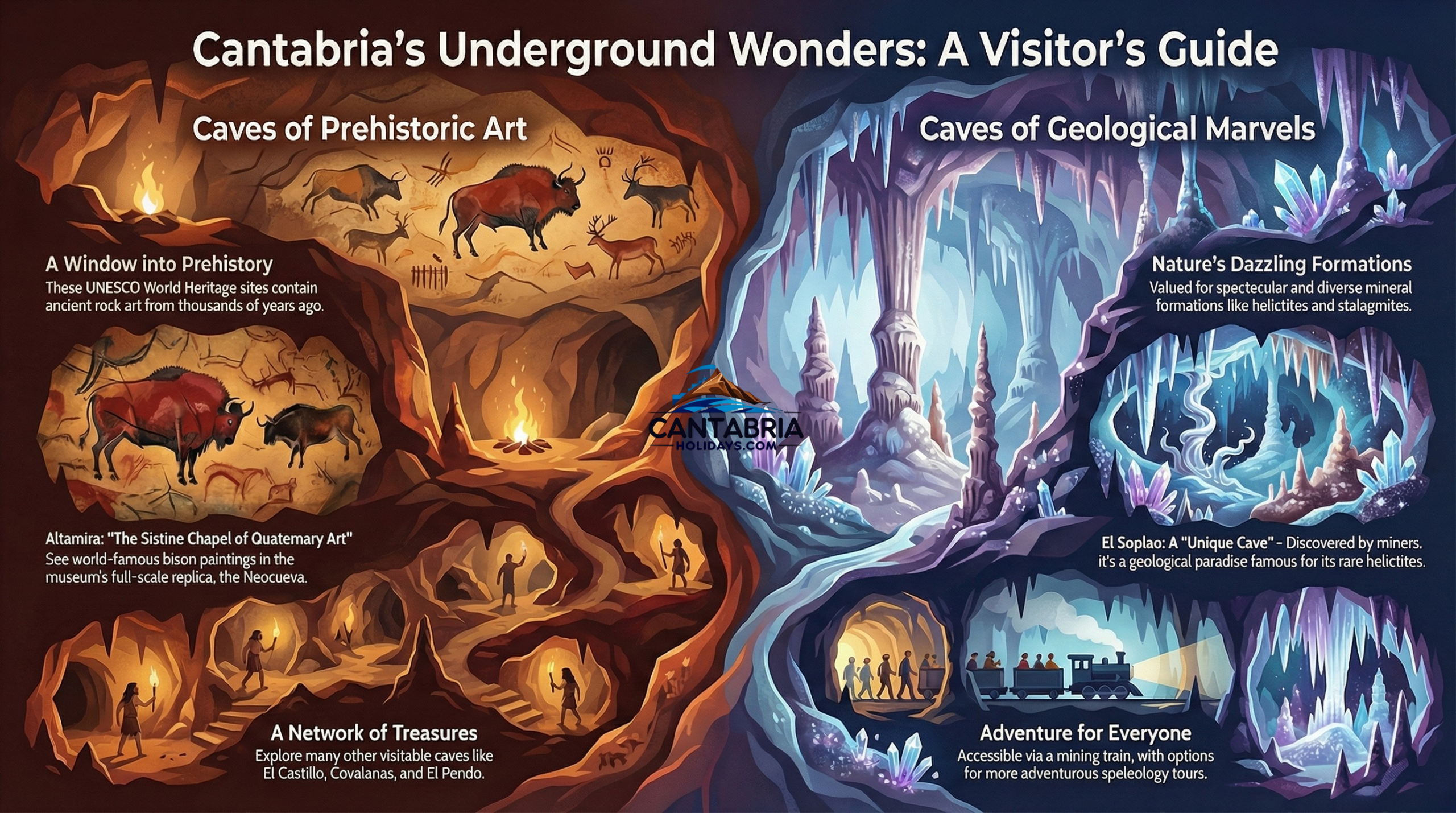
Here is the first and perhaps most important truth for any prospective visitor: the original Altamira cave is closed to the public. The delicate, 35,000-year-old paintings that earned it the name “Sistine Chapel of Quaternary art” are too fragile to withstand the environmental changes caused by our very presence.
Instead, visitors explore the “Neocueva of the Altamira Museum,” a meticulous replica located just meters from the original. This is a fascinating paradox of modern tourism: to truly honor a place, we must agree to visit its perfect ghost. The replica allows us to stand in the heart of that ancient darkness, to gaze up at the thundering herd on the ceiling, and feel the same awe without casting a destructive shadow. Altamira’s closure marked a turning point, a moment the world recognized that some treasures must be protected from the very people who cherish them most.
2. One of Geology’s Greatest Wonders Was Discovered by Accident
The story of the El Soplao cave doesn’t begin with archaeologists seeking the dawn of humanity, but with 20th-century miners seeking zinc and lead. Around 1908, while carving out a tunnel, workers unexpectedly broke through into a vast, hidden chamber. The industrial world literally pierced the wall of a geological one. The rush of air they felt gave the cave its name; “El Soplao” is a mining term for the “blowing air” felt when one passage connects to another.
This humble origin stands in stark contrast to the cave’s status as “one of the greatest wonders of geology.” What was once just an obstacle in a mining operation is now celebrated as a “true speleology paradise,” a powerful reminder that the earth keeps its most profound secrets hidden, often revealed not when they are sought, but when they are accidentally stumbled upon by men with drills and dynamite.
3. These Caves Are Time Capsules of Both Nature and Industry
While prehistoric paintings are a major draw, Cantabria’s underground world is not just an ancient art gallery. Here, timelines collide. El Soplao is the ultimate example, a place that chronicles the history of both the planet and the people who worked it. The slow, patient artistry of dripping water over millennia, which sculpted the “abundance, spectacularity and diversity of its helictite formations,” exists alongside the brute-force ambition of miners who carved 20 kilometers of tunnels in mere decades. One tells the story of the planet; the other, the story of human industry.
This dual identity appears elsewhere, too. Visitors to Cueva de Las Monedas are often surprised to find that, in addition to prehistoric drawings, the cave is a natural spectacle filled with spectacular calcareous formations like towering stalagmites and delicate columns, proving that these chambers have always been canvases for more than one kind of artist.
4. They Were Homes for Over 150,000 Years—Not Just Art Galleries
Standing in the cool silence of Cueva de El Castillo, a profound realization dawns: you are not in a gallery. You are in a home. The art is so captivating that we forget its context, but the timescale of habitation here is staggering. Evidence shows El Castillo was lived in for an astonishing 150,000 years, a continuous thread of existence that dwarfs all of recorded history.
These masterpieces weren’t created for a distant audience; they were woven into the very fabric of daily life—stories told by firelight, rituals performed in the deep, resonant darkness of a familiar shelter. Nearby, Cueva de Hornos de la Peña offers a rare window into the coexistence of different human species, having served as a home to both “the last neandertals of the north peninsular and the first Homo sapiens of Cantabria.” To see these caves as living spaces fundamentally changes their meaning, transforming them from galleries of ancient objects into resonant, deeply human sanctuaries.
5. Altamira Is Just the Tip of the Ice Age
While Altamira is rightfully world-famous, it is only one star in a vast constellation. To focus on it alone is to miss the staggering richness of the region’s prehistoric legacy. Cantabria is home to a sprawling network of decorated caves, with ten—including El Castillo, Las Monedas, Covalanas, Chufin, and El Pendo—forming part of a collective UNESCO World Heritage site. Each offers a unique style and story, contributing to a more complete picture of Paleolithic life.
This broader perspective is essential. The caves are not isolated attractions but anchors in a landscape dense with history. This perspective is perfectly captured in the advice offered to visitors of El Soplao:
When you come to El Soplao, friends, do not limit your visit to the Cave, one of the greatest international monuments of geology.
The message is clear: lift your eyes from the cave entrance and see the whole story. Explore the surrounding geo-mining environment, walk the ancient network of trails, and discover the tiny villages with their traditional rural architecture. The true significance of Cantabria’s past is found not just underground, but in the connections between the caves, the mountains, and the culture that grew up around them.
Conclusion: A Deeper Past to Ponder
The legendary caves of Cantabria offer an experience that goes far beyond ancient art. They are windows into the slow, patient work of geology, the grit of modern industry, and the immense, almost unimaginable timeline of human history. They challenge our perceptions and reward our curiosity with a story far more intricate than a single, famous painting.
As we stand at the threshold of these ancient homes, what echoes from our deep past do we hope to hear?