
Cantabria: A Journey into Infinite Spain
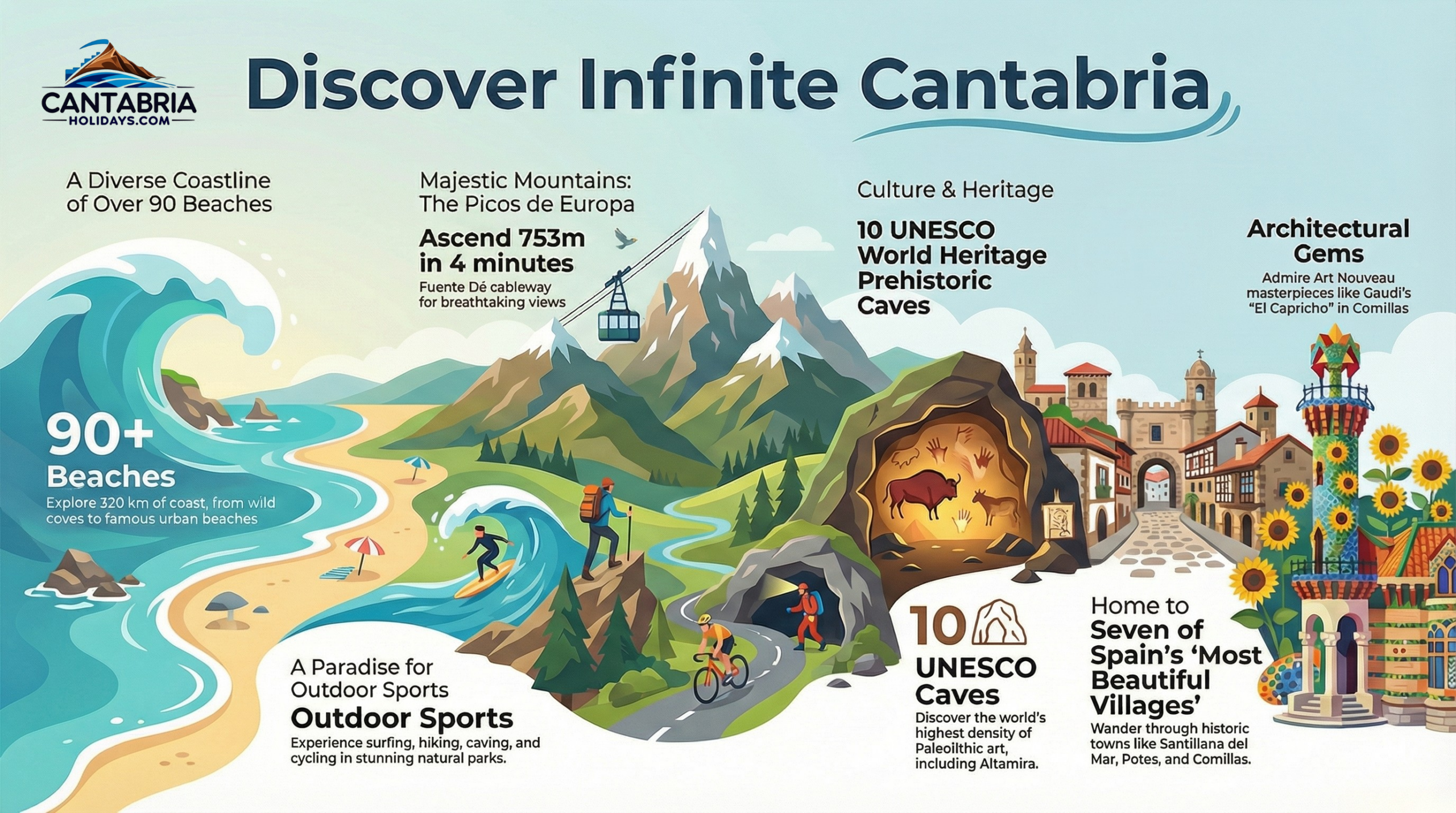
Imagine a land where lush green mountains tumble into the turquoise expanse of the sea, where ancient history is etched into the walls of caves and medieval villages, and where every winding road reveals a new, breathtaking vista. This is Cantabria, a region of stunning diversity nestled in the heart of “Green Spain.” It is a destination that defies easy definition, offering a unique and deeply personal adventure for every type of traveler. This is Infinite Cantabria.
For the thrill-seeker, it is a coastline of legendary waves and soaring mountain peaks. For the history lover, it is a journey to the dawn of human art and along centuries-old pilgrimage routes. For the gourmand, it is a feast of flavors drawn from both the bountiful Cantabrian Sea and the fertile inland valleys. Whether you dream of surfing pristine beaches, hiking through enchanted forests, marveling at architectural wonders, or simply savoring the rhythm of a culture rich in tradition, Cantabria holds an unforgettable story waiting just for you.
Join us on a narrative journey through the captivating experiences that make this compact yet boundless region one of Europe’s most authentic and rewarding destinations.
2.0 The Majestic Coastline: Where Green Meets Blue
Cantabria’s identity is inextricably linked to its dramatic 220-kilometer coastline. This is not just a geographical boundary but a vibrant cultural and natural hub, home to over 90 distinct beaches, historic maritime towns, and geological formations that tell a story millions of years in the making. From the elegant promenades of its capital to the wild, windswept coves carved by the relentless sea, the coast is the region’s dynamic soul, offering a perfect fusion of nature, history, and adventure.
2.1 A Shore for Every Dream
The sheer variety of Cantabria’s beaches is astonishing. Here, every traveler can find their personal paradise. The coast offers everything from the grand, urban sands of El Sardinero in Santander to the wild, secluded beauty of coves like Berellín, a hidden gem surrounded by unique rock formations.
This diversity makes the coastline a premier destination for watersports. Surfers flock to the legendary waves of Langre and Los Locos in Suances, while the gentler waters in other areas are perfect for sailing, paddle surfing, and kite-surfing. Nature lovers will be drawn to Oyambre, a magnificent, well-preserved beach set within a natural park between Comillas and San Vicente de la Barquera. For a unique urban beach experience, El Puntal offers a spectacular sandy spit with fantastic views across the bay to Santander’s Magdalena Palace. Demonstrating a commitment to inclusivity, La Arena beach holds a universal accessibility certification from AENOR, ensuring its services and access are open to all.
2.2 Historic Harbors and Coastal Jewels
Woven into this coastal fabric is a string of historic towns, each with its own proud seafaring tradition and unique character. Our coastal journey begins in the east, at the medieval port of Castro-Urdiales, where the magnificent Gothic church of Santa María stands sentinel beside its castle-lighthouse, a powerful silhouette against the Cantabrian sky. This town, with Roman roots and narrow, charming streets, offers a perfect introduction to the region’s deep history.
Traveling west, the coastline unfolds to reveal Laredo, famed for its spectacular 4-kilometer beach, “La Salvé.” This stunning stretch of sand and dunes has earned the prestigious “Q” for tourist quality from AENOR, a testament to its exceptional beauty and facilities. A short distance away lies Santoña, a town renowned globally for its world-class anchovies. Guarded by Napoleonic-era forts on Mount Buciero, Santoña is also the gateway to the vital wetlands of the Marshes of Santoña Natural Park, a haven for migratory birds.
The journey continues to Santander, the region’s elegant capital, celebrated for its spectacular bay—one of the most beautiful in the world. It is a city of captivating contrasts, from the royal grandeur of the Magdalena Palace and the iconic El Sardinero beach to the striking contemporary architecture of the Centro Botín art center. Moving west again, we reach Suances, a vibrant hotspot for surfers, where the powerful waves of the Cantabrian Sea draw enthusiasts from across the globe to its famed Los Locos beach.
Further along the coast, Comillas presents a captivating dual identity. It retains the charm of a traditional fishing village while serving as Cantabria’s most important hub of Art Nouveau architecture, famously home to El Capricho, a whimsical masterpiece by the brilliant Antoni Gaudí. Our coastal exploration concludes in San Vicente de la Barquera, a quintessential fishing town steeped in seafaring history. Its iconic image is the long bridge leading to the old town, perfectly framed by the soaring peaks of the Picos de Europa in the background—a view that captures the very essence of Cantabria’s soul.
2.3 The Sculpted Coast: A Geological Masterpiece
The Cantabrian coast is also an extraordinary geological gallery, shaped by the forces of nature over millennia. Its most spectacular section, the Costa Quebrada (Broken Coast), was recently designated a UNESCO Global Geopark. This stretch of coastline is a veritable “open-air geology lesson” with a history stretching back 125 million years, featuring a dramatic succession of cliffs, fossil-rich rock stratifications, islets, and wild coves.
All along the shore, nature’s artistry is on display in whimsical rock formations that have sparked the human imagination. In Santander, the tide reveals the iconic “Camel Rock,” while near Castro-Urdiales, “The Whale” of Sonabia appears to emerge from the waves. These formations are a testament to the powerful, creative forces that have sculpted this unforgettable coastline.
The same elemental forces that sculpted this unforgettable coastline also raised the magnificent peaks and carved the verdant valleys that define Cantabria’s soul, inviting us to journey beyond the shore.
3.0 Beyond the Shore: A Journey into Verdant Valleys and Soaring Peaks
While the coast is Cantabria’s brilliant facade, its soul resides in the dramatic interior. Here, the landscape transforms from coastal plains into a world of “fabulous mountains” forged during the Alpine orogeny, lush valleys carved by crystal-clear rivers, and unique wildlife sanctuaries. This is the Cantabria of deep greens and soaring grays, a region where nature commands respect and inspires awe at every turn.
3.1 The Call of the Wild: Picos de Europa and Beyond
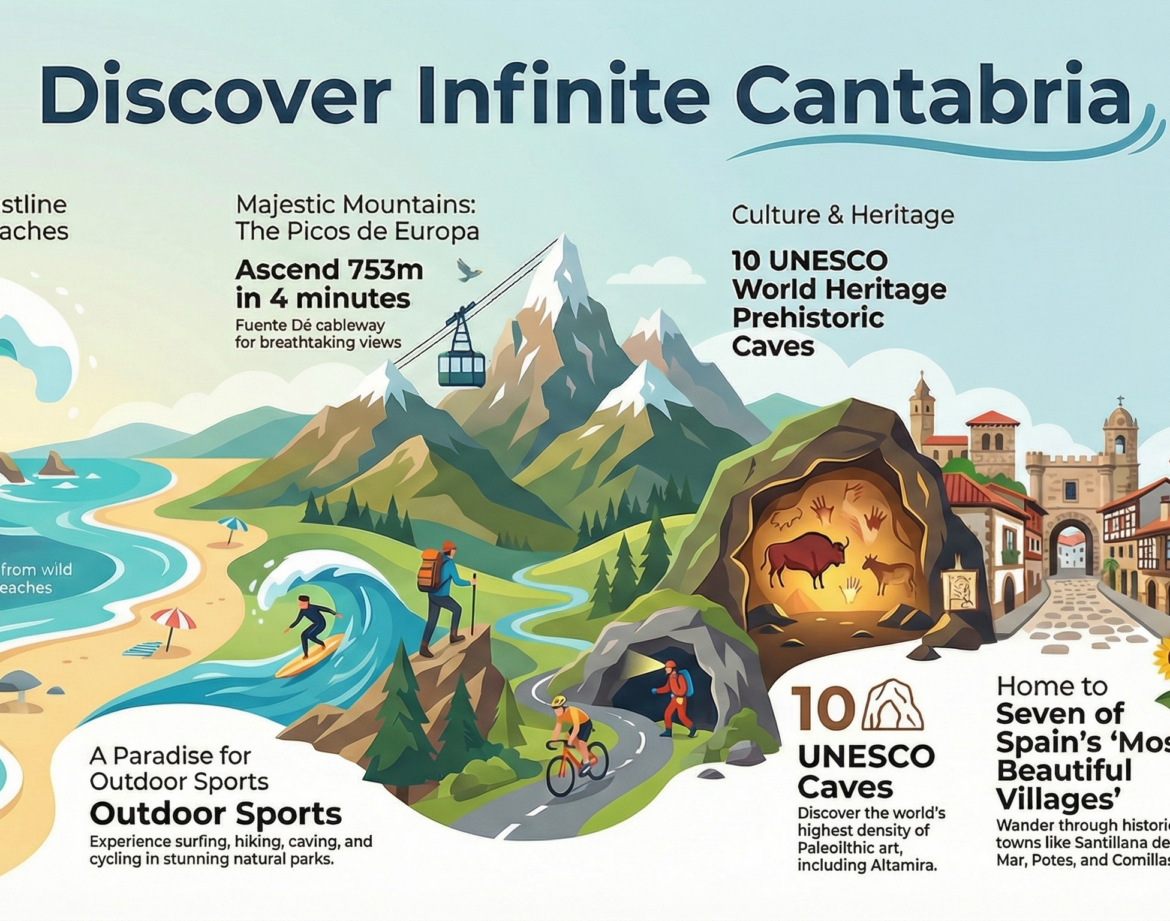
The crown jewel of Cantabria’s interior is the Picos de Europa National Park, a majestic limestone massif that offers a premier destination for hikers and nature lovers. The most dramatic entry point is the Fuente Dé Cableway, an exhilarating experience that ascends 753 meters in just four minutes. From the upper station at an altitude of 1,823 meters, visitors are greeted with breathtaking panoramas and direct access to the heart of the park’s high-mountain trails.
Further south, the Campoo region presents a different but equally compelling landscape. It is a land of high peaks and the source of three major rivers—the Ebro, Pisuerga, and Nansa—which uniquely flow to three different seas: the Mediterranean, the Atlantic, and the Cantabrian. In winter, this area transforms into a paradise for snow and adventure sports at the Alto Campoo ski station.
3.2 The Secret Cantabria: Enchanted Forests and Hidden Landscapes
Beyond the well-known peaks lie the hidden corners of a secret Cantabria, places of quiet magic and profound natural beauty. The Valles Pasiegos offer a quintessential Cantabrian experience, particularly along the scenic Alto del Caracol mountain pass. Here, a serpentine road carves through a landscape of almost impossible emerald green, where low-hanging mists swirl around traditional stone cabañas, and the silence is so profound it feels like a presence.
For those who seek the tranquility of the woods, Cantabria is home to several magical forests, each with a unique character:
- Cabezón de la Sal Redwood Forest: A surprising and enchanting “Californian forest” in the heart of Cantabria, where colossal redwood trees soar over 30 meters high, creating an atmosphere of awe and wonder.
- Habarío of Pembes: Located in the Liébana valley, this is a serene grove of centuries-old oaks, whose ancient, twisted trunks seem like sculptures crafted by time itself.
- Monte Tejas Mythological Forest: A place where nature and legend intertwine. A trail winds through the woods, revealing sculptures of mythical creatures from Cantabrian folklore, such as the one-eyed giant ojáncano and the benevolent fairy anjana, bringing ancient stories to life.
3.3 An Unforgettable Encounter: The Wildlife of Cabárceno
No exploration of Cantabria’s nature is complete without a visit to the Cabárceno Nature Park. This is an experience truly distinct from a traditional zoo. Set within a beautifully restored former iron mine, the park’s 750 hectares provide a stunning home for animals from all five continents who live in vast, semi-free enclosures.
Visitors can drive along 20 kilometers of internal roads to observe elephants, giraffes, brown bears, gorillas, and even Bengal tigers roaming in expansive, naturalized habitats. For a different perspective, a cable car ride offers breathtaking aerial views of the animals and the park’s unique karstic landscape. The experience is further enriched by spectacular birds of prey and sea lion demonstrations, making Cabárceno a world-class center for wildlife conservation, education, and tourism.
This profound natural beauty is not an empty wilderness; it is a landscape deeply inscribed with millennia of human history, from the first strokes of genius in Paleolithic caves to the grand ambitions of kings and pilgrims.
4.0 Echoes of Time: A Tapestry of Millennia
Cantabria is a land where history is not confined to museums; it is written in the very stone of the earth. From the dawn of human creativity in Paleolithic caves to the architectural elegance of the 20th century, the region offers an exceptionally deep and layered cultural heritage. To travel through Cantabria is to walk through time, discovering a rich tapestry of art, faith, and innovation that has shaped this land for millennia.
4.1 The Dawn of Art: Journey into Prehistoric Caves
Cantabria stands as a global epicenter of Paleolithic art, boasting the world’s highest density of caves with prehistoric paintings. Over 60 decorated caves have been documented here, with an astonishing ten of them collectively designated as a UNESCO World Heritage Site.
The undisputed crown jewel is the Altamira Cave, revered as the “Sistine Chapel of cave art.” Its magnificent polychrome bison ceiling, painted over 14,000 years ago, represents a pinnacle of human creative genius. To ensure its preservation, the original cave is protected, but visitors can experience its full wonder through the meticulous, exact replica housed at the Altamira Museum in Santillana del Mar. Beyond Altamira, the heritage is vast. Other visitable UNESCO caves, such as El Castillo, with its great variety of techniques, themes, and styles, Las Monedas, and Covalanas, known as “the cave of the red deer,” offer an unparalleled journey into the mind of our earliest ancestors.
4.2 From Romans to Pilgrims: A Path Through History
The layers of history continued to build after the prehistoric era. The Roman Empire left its mark with settlements like the ruins of Julióbriga, the best-preserved Roman city in the region. Centuries later, Cantabria became a crucial passage for Christian pilgrims. Today, it is the only region in the world with two UNESCO World Heritage pilgrimage routes.
The Northern Way, a spectacular coastal segment of the famous Camino de Santiago, guides pilgrims through stunning seaside landscapes. Branching inland is the unique Lebaniego Way, a deeply spiritual 72-kilometer route that leads through the dramatic Picos de Europa to the Monastery of Santo Toribio de Liébana. This monastery is one of Christianity’s holiest sites, as it houses the Lignum Crucis, the largest known piece of the cross upon which Jesus was crucified.
4.3 The Architectural Dream: Gaudí and the Art Nouveau Legacy
At the turn of the 20th century, Cantabria became a canvas for the revolutionary Art Nouveau movement, known in Spain as Modernism. The seaside town of Comillas emerged as the movement’s heartland, thanks to the patronage of the Marquis of Comillas, who commissioned leading Catalan architects to create a stunning architectural ensemble.
The town’s most iconic buildings include the magnificent neo-Gothic Palace of Sobrellano, the impressive Pontifical University, and, most famously, “El Capricho,” an imaginative and colorful summer villa designed by a young Antoni Gaudí. This rich architectural legacy extends beyond Comillas, with other superb examples found across the region, including the elegant Gran Casino del Sardinero and the beautiful iron-and-glass Mercado de la Esperanza in Santander.
This deep historical legacy is not confined to the past; it flows directly into the vibrant living culture of today, a culture best understood through its authentic flavors and timeless traditions.
5.0 The Soul of Cantabria: Flavors, Traditions, and Lifestyles
The true character of Cantabria is revealed not just in its landscapes and monuments, but in its living culture—a vibrant tapestry of authentic flavors, charming villages, and a deep connection to the land. Exploring this soul means tasting the bounty of its sea and mountains, wandering the cobbled streets of perfectly preserved towns, and embracing a lifestyle that offers adventure for both body and spirit.
5.1 A Taste of the Land and Sea
Cantabrian gastronomy is a delicious reflection of its geography, drawing the finest ingredients from both the sea and the mountains. The cuisine is honest, flavorful, and deeply rooted in tradition, offering a memorable experience for every palate.
- From the Sea: The coast provides unparalleled seafood. Must-try delicacies include the world-famous, exquisite anchovies of Santoña, the universally loved fried rabas (squid), and hearty seafood stews like marmita or sorroputún, a tuna and potato dish traditional to the fishing ports.
- From the Mountains: The interior offers robust and satisfying dishes. The two iconic stews are Cocido Lebaniego (a chickpea-based stew from the mountains of Liébana) and Cocido Montañés (a hearty white bean and cabbage stew typical of the wider region), both rich with local meats. The region is also celebrated for its high-quality beef.
- From the Valleys: The lush Valles Pasiegos are home to Cantabria’s most iconic pastries. No visit is complete without tasting the rich, buttery sponge cake known as sobaos and the delicate cheesecake called quesadas.
- Local Liqueurs: In the town of Potes, at the foot of the Picos de Europa, local artisans produce the famous orujo, a traditional pomace brandy that provides a fiery and authentic finish to any meal.
5.2 The Seven Jewels: Cantabria's Most Beautiful Villages
Cantabria is home to an extraordinary collection of beautifully preserved towns, seven of which are officially recognized on the prestigious “Most Beautiful Villages in Spain” list. These are not mere tourist stops but living repositories of Cantabrian identity, where cobbled lanes, stone manor houses with flower-laden wooden balconies, and a palpable sense of history transport the visitor to a quieter, more profound era.
The seven jewels are Potes, Santillana del Mar, Carmona, Bárcena Mayor, Mogrovejo, Liérganes, and Comillas. Each offers a unique window into the region’s past, inviting visitors to wander and lose themselves in time.
5.3 Adventures for the Spirit and Body
For the active traveler, Cantabria is a natural playground offering a vast range of activities. Climbers and thrill-seekers can test their skills on the four vias ferratas located in the Liébana region. The opportunities for hiking and cycling are nearly endless, with scenic routes like the Vías Verdes (Greenways) that follow converted railway lines through picturesque valleys.
For a different kind of adventure, the region is home to several unique labyrinths that offer fun for all ages. The most impressive is the Laberinto de Villapresente, Spain’s largest green labyrinth, where getting lost among the tall cypress hedges is part of a delightful challenge.
From its flavors to its adventures, Cantabria offers a complete and immersive experience, tying all its unique elements into a single, compelling story.
6.0 Conclusion: Your Unforgettable Cantabrian Story Begins Now
Cantabria is a revelation—a compact yet infinitely diverse region that delivers a rich, authentic, and remarkably accessible European travel experience. It is a land of breathtaking contrasts, where a world-class coastline gives way to majestic peaks, where the dawn of art coexists with contemporary culture, and where every meal is a celebration of the land and sea. This is the promise of “Infinite Cantabria”: a destination that offers a personal and unforgettable journey for everyone.
Getting here is simpler than ever. The Seve Ballesteros-Santander Airport, located just five kilometers from the capital, provides direct and convenient connections to numerous European cities, placing this extraordinary corner of Spain within easy reach.
The soaring mountains, the crashing waves, the echoes of history, and the vibrant flavors are all waiting. Stop dreaming of your perfect adventure and start planning it. Your unforgettable Cantabrian story begins now.