
Beyond the Peaks: 5 Unexpected Discoveries in Spain’s Liébana Valley
While the imposing peaks of the Picos de Europa draw travelers from across the continent, the true magic of Spain’s Liébana Valley is found in the surprising details on the ground. Beyond the famous mountain routes lies a world of profound history, unique culture, and storybook villages. This is a guide to the unexpected experiences that reveal the region’s deeper story.
1. You can take a 4-minute shortcut to the heavens.
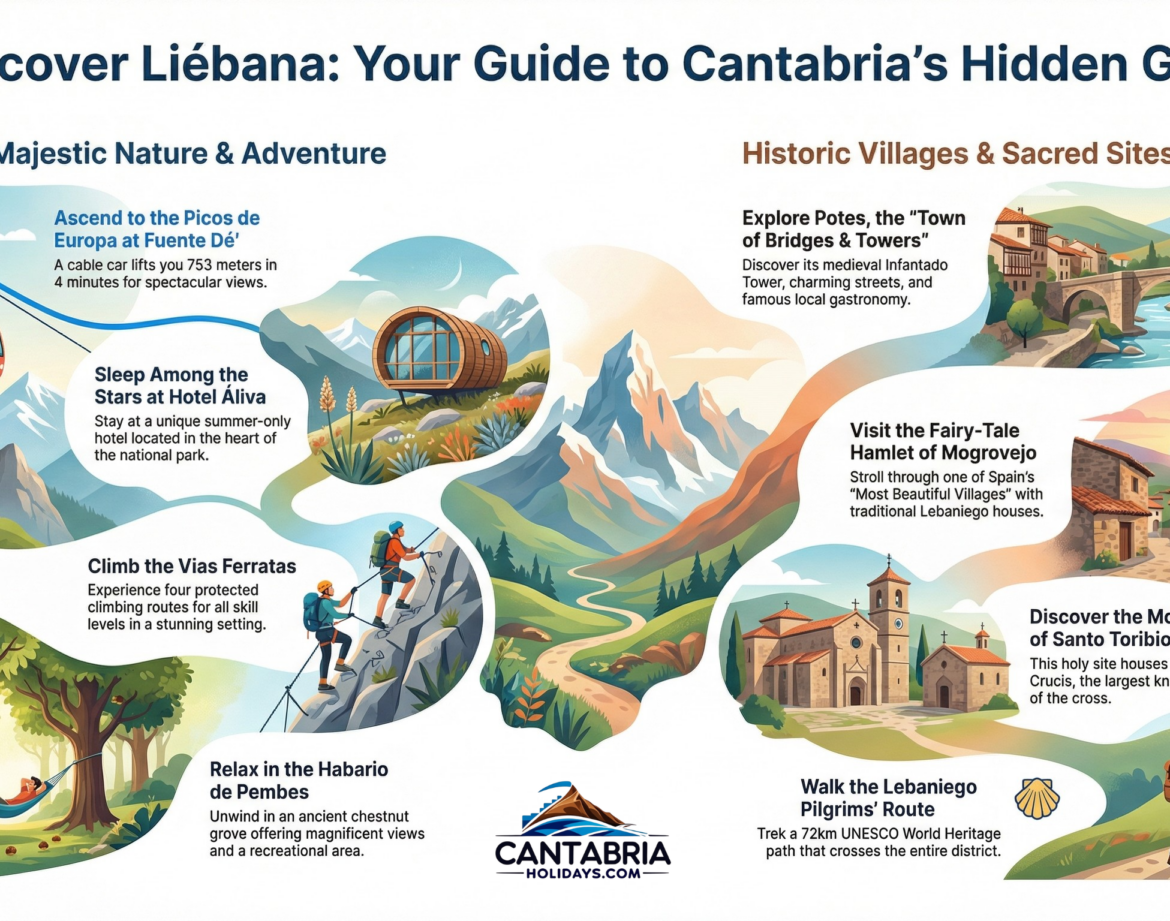
The Fuente Dé Cableway offers a dramatic and immediate ascent, launching you to an alpine world at 1,823 meters. In just four minutes, the lift soars 753 meters, providing the easiest possible access to the high-altitude heart of the Picos de Europa National Park.
For a truly profound immersion, you can stay at the Hotel Áliva, a family-run refuge located less than an hour’s hike from the cableway’s upper station. Open exclusively in the summer, it offers the rare opportunity to sleep “almost touching the stars” amid an unmatched landscape. This combination of extreme accessibility and deep seclusion offers a chance to commune with nature in its purest form.
2. One of Spain's 'Most Beautiful Villages' is a real-life fairy tale.
In 2020, the small hamlet of Mogrovejo was officially included in the list of the “Most Beautiful Villages in Spain,” and it’s easy to see why. It is an “idyllic spot like a fairy tale setting,” where the rocky walls of the Picos de Europa seem to “stand out from the roofs of the houses.”
The village is a living museum of traditional Lebaniegan architecture, with houses featuring an upper floor whose walls are made of interwoven branches covered with a mud coating, a space typically used as a hayloft. Some homes show an Asturian influence with an exterior staircase. Guarded by a formidable medieval tower from the late 13th century and a 17th-century parish church, Mogrovejo is impactful not just for its age, but for preserving a unique, storybook character that feels like stepping into a painting.
3. A secluded monastery holds one of Christianity’s most significant relics.
A few kilometers from Potes, the Gothic Monasterio de Santo Toribio is a site of holy pilgrimage. The presence of one particular artifact transforms the monastery from a regional landmark into one of Christianity’s most sacred pilgrimage sites. What makes it a holy site is the Lignum Crucis, which the church attests is:
…the largest part of the Cross of Jesus that exists, where Jesus Christ died.
This sacred site is the final destination of the Lebaniego Pilgrims’ Route, one of two UNESCO World Heritage pilgrim routes in Cantabria. To find a relic of such global significance tucked away in this remote mountain valley is a stunning discovery, making a visit here an unexpectedly moving experience.
4. The region's capital is a labyrinth of towers, bridges, and potent liqueur.
At the very heart of Liébana, where the Deva and Quiviesa rivers merge, the town of Potes rises—a capital carved from stone, bridges, and tradition. Like the nearby hamlet of Mogrovejo, Potes has earned its place among Spain’s most beautiful villages, but where Mogrovejo offers storybook tranquility, Potes buzzes as the region’s living, breathing heart.
Its history is written in its architecture, earning it the nickname the “town of bridges (hence its name) and towers,” including the 15th-century Torre del Infantado and Orejón de la Lama. Beyond its stone walls, Potes is a vibrant hub of gastronomy. Its culinary star is the hearty Cocido Lebaniego, but the region’s most famous artisan product is orujo, a potent liqueur. Orujo is so central to the culture that it has its own annual festival in November, declared a Festival of National Tourist Interest. Potes is far more than a scenic stop; it’s a living center of history and culinary tradition.
5. World-class adventure is free, but you'll still want an expert.
For adventure seekers, Liébana offers some of the most spectacular vias ferratas (protected climbing routes) in Spain. There are four lines in the district—two in La Hermida, one in Camaleño, and one in Vega de Liébana—with difficulties ranging from easy to medium-high. These routes offer stunning climbs for outdoor sports enthusiasts.
The most surprising aspect is a policy that embodies both freedom and pragmatism:
…the access to the vias ferratas is free, it is always recommended to hire an expert who will guide and help you when required.
This dynamic creates a fascinating balance: the freedom of open access to world-class routes is paired with the essential wisdom of seeking professional guidance to ensure a safe and successful climb.
Conclusion: The Soul of the Valley
Liébana’s true appeal is found in the rich blend of awe-inspiring nature, profound history, and living culture that exists just beyond the famous peaks. It’s a place where one village preserves its fairy-tale architecture, while a nearby monastery guards a relic of global importance. When you travel, what hidden stories do you hope to find just beyond the famous landmarks?