
5 Surprising Truths About Cantabria’s Costa Quebrada, Spain’s Newest UNESCO Geopark
Introduction: Beyond the Postcard
Picture a rugged coastline: wild cliffs carved by a relentless sea, golden beaches tucked into hidden coves, and dramatic rock formations rising from the waves. It’s a classic image of natural beauty, the kind you’d find on a postcard. But what if that landscape was more than just a pretty view? What if it was an open-air museum, a library where the story of our planet is written in stone?
This is Cantabria’s Costa Quebrada, or “Broken Coast.” For years, it has been a beloved destination for those in the know, but its spectacular scenery holds deeper meanings. It tells a dramatic, 120-million-year-old story of continental shifts, ancient tropical seas, and the raw power of nature. This profound geological heritage has recently earned it a place on the world stage.
Here are five surprising truths about this remarkable stretch of coastline that reveal why it’s so much more than just a beautiful place, and why it’s now officially recognized as a global treasure.
1. It’s Not Just a Local Gem—It’s Officially a Global Treasure
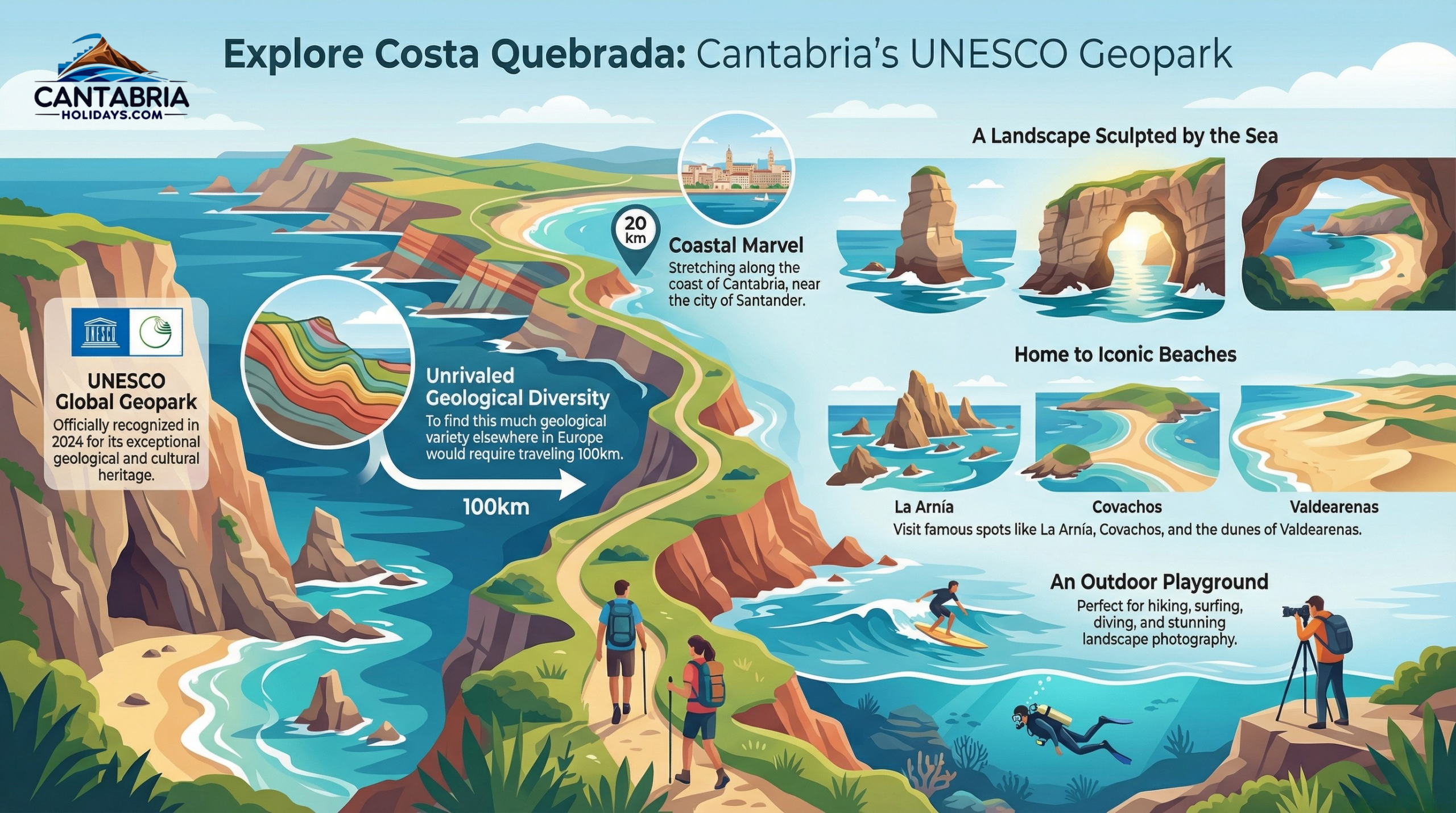
The biggest news, and the most important secret to share, is that Costa Quebrada is no longer just a regional highlight. On September 7, 2024, it was officially designated a UNESCO Global Geopark, a status that confirms its place among the world’s most important geological sites.
This isn’t an award given lightly. It places the Costa Quebrada in an elite global network of 147 parks spread across 41 countries. To be included, a site must possess not only outstanding geological heritage but also a rich tapestry of human history and cultural significance. Costa Quebrada delivers on all fronts, demonstrating the profound connection between people and the planet throughout history.
This official recognition matters because it transforms a stunning local landscape into a site of global importance. It’s an acknowledgment that the story told by these cliffs and coves is part of humanity’s shared story of Earth’s evolution.
2. It’s a Geological Expressway: 100 Kilometers of History in a 20-Kilometer Walk
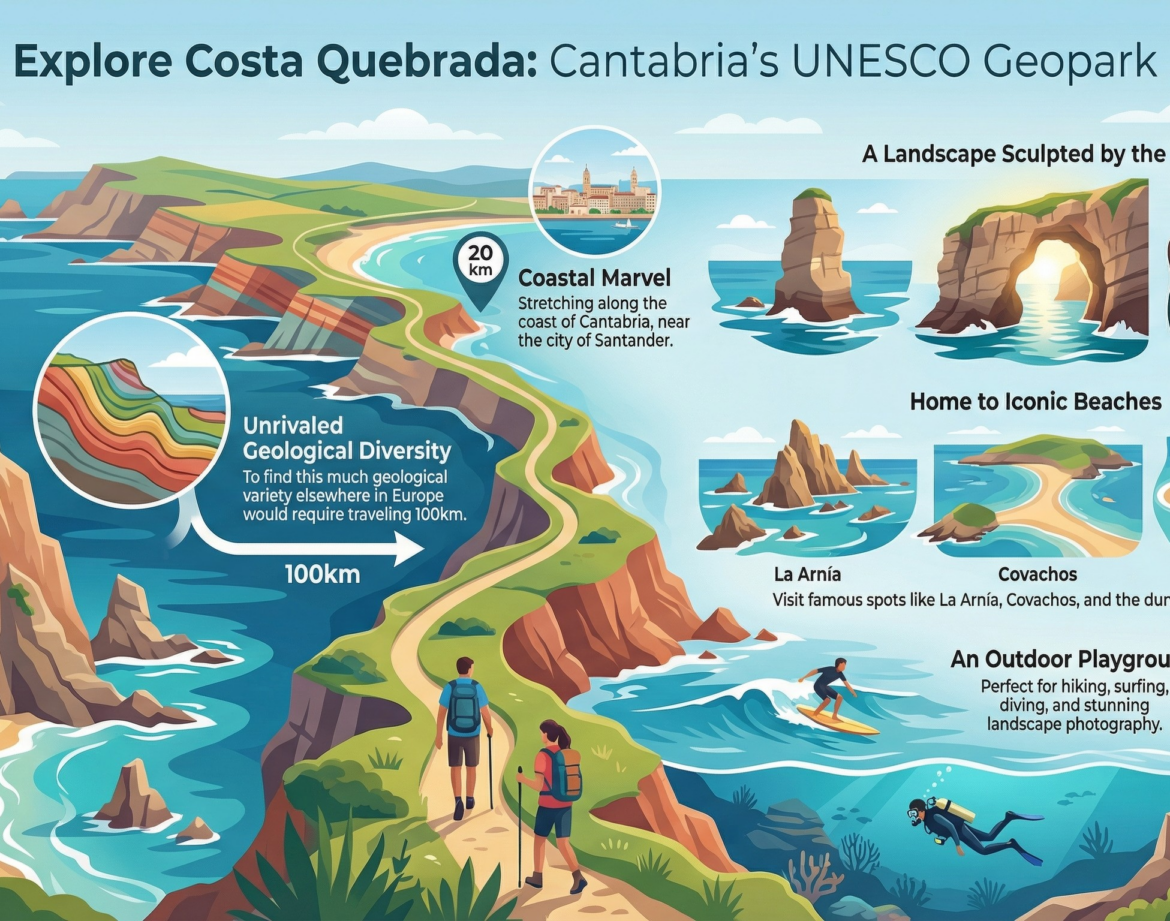
Here is perhaps the most astonishing fact about the Costa Quebrada: to find the same geological diversity packed into its 20-kilometer stretch, you would have to travel at least one hundred kilometers anywhere else in Europe. It is, in effect, a geological expressway—a compressed timeline of our planet’s history made incredibly accessible.
In a single walk, you can witness the remnants of ancient tropical reefs, see ecosystems frozen in time, and observe the evidence of the cataclysmic events that wiped them out. It’s a place that impresses even those who think rocks have nothing to say. The landscape is a living classroom, where complex Earth science becomes intuitive and awe-inspiring.
Geology here is, without a doubt, for everyone.
This short coastal path showcases an incredible variety of features sculpted by time and the sea, from the iconic sea stacks at La Arnia—with its platform of abrasion and rocky crests emerging from the water—to the tombolo-connected island at Covachos and the vast dune system at Liencres. Further along, the beach at Portio offers a fascinating view of inclined and eroded sedimentary rock layers. But this ancient stage is no relic; these same formations create a world-class playground for sports, hosting the international giant wave surfing championship La Vaca Gigante and offering spectacular routes for diving and trail running.
3. The Park Doesn't Stop at the Water's Edge
While its name highlights the coast, it’s a mistake to think the park’s wonders end where the cliffs meet the land. The Costa Quebrada Geopark is far more extensive than most visitors realize.
The officially designated territory covers a total area of 345 km², with 270 km² of land and 75 km² of sea. This area spans eight different municipalities: Santander, Santa Cruz de Bezana, Piélagos, Miengo, Suances, Santillana del Mar, Polanco, and Camargo.
This means the park’s heritage extends inland to protect sites of immense historical and cultural value. A prime example is the El Pendo cave, a place that deepens the park’s story by connecting its surface geology to the earliest chapters of human history. This inland territory also encompasses sites of global significance, including the area around the unparalleled jewel of the region: the world-renowned Altamira Cave, connecting the Geopark’s deep time to the dawn of human artistry. This broader scope makes the Geopark a true “ecological corridor,” linking the marine environment with coastal habitats and inland landscapes in a single, cohesive story.
4. A Coastline Forged by Both Time and Tragedy
The dramatic beauty of the Costa Quebrada tells stories on two vastly different scales: the immense, slow grind of geological time and the sudden, poignant moments of human history.
The iconic Urros de Liencres are a perfect example of nature’s artistry. These limestone sea stacks, standing like sentinels against the Cantabrian Sea, are the result of millions of years of relentless erosion—a testament to nature’s power to sculpt and destroy. They are a visual reminder of a planet constantly in flux.
Juxtaposed with this deep time is a deeply human story. On the islet of the Virgen del Mar, a pristine white hermitage stands watch over the coast. It serves not only as a place of protection for sailors but also as a memorial to a specific, devastating tragedy: the tragic Galerna of Holy Saturday, 1878. On a single day, this ferocious storm claimed the lives of 254 fishermen. The chapel is a quiet reminder that this beautiful coast has also been a place of profound loss. This blend of natural grandeur and human history gives the landscape a deeper, more resonant meaning.
5. Its Wild Beauty Demands Respect
For anyone planning a visit, here is a final, practical truth: this is not a tame, manicured park. Its wildness is a core part of its appeal, and it demands awareness and respect.
While the coastal trail is accessible to most, it has its challenges. In the area of La Arnia, for instance, the constant push of the sea has eroded a section of the path, requiring a careful detour. This is a coast that is actively being shaped before your eyes.
Furthermore, accessing some of its most spectacular beaches requires effort. The breathtaking nudist cove of Somocuevas, for example, can only be reached by descending 139 steps carved directly into the cliffside. This isn’t a deterrent but a reminder: the untamed character of the Costa Quebrada is precisely what makes it so unforgettable.
Conclusion: A Story Written in Stone
The Costa Quebrada is far more than a destination; it’s an experience. It’s a journey that connects you to the deep, powerful forces that have shaped our world. To walk its cliffs is to read a story written in stone, a narrative of creation, destruction, and resilience that spans millions of years.
With its new UNESCO status, this incredible open-air museum is ready to share its secrets with the world. The next time you walk along a coast, will you wonder what stories are written in its rocks?